Are intrusive thoughts normal?

 The short answer
Yes. Unwanted, ugly, out-of-character thoughts are close to universal: most people without OCD report thoughts with the same content as clinical obsessions, and that holds across cultures. What makes it OCD isn't the thought, it's the meaning you give it and what you do next. If a thought feels like evidence and you have to resolve it, that's the loop, not the thought.
Are intrusive thoughts normal?
Yes. This is one of the few questions about OCD with a clean answer.
In the late 1970s, researchers asked people with no diagnosis and no treatment history to report the unwanted thoughts that showed up in their heads. Most of them reported thoughts with the same content as clinical obsessions: harm, sex, blasphemy, contamination, doubt. Same content. The difference between the clinic group and everyone else wasn’t the subject matter.
That wasn’t a quirk of one decade in one country. In a study spanning six continents, nearly everyone reported an intrusive thought in the previous three months. Different languages, different religions, different values, same ugly flashes.
So if you’ve been treating the existence of the thought as the evidence, the evidence is thinner than it feels. Nearly everyone has the thought. Far fewer people have the loop.
Here’s the part you probably don’t want. We’re not going to tell you what your particular thought means about you. That’s exactly what OCD sent you to Google for, and handing it over is what keeps the machine fed. “Maybe, maybe not” is the honest sentence, and it’s also the one that starves the loop.
What do intrusive thoughts look like across themes?
The content varies wildly between people and it changes within one person over the years. A few of the common shapes:
- Harm: a flash of hurting someone, including someone you’d never want to hurt.
- Contamination: a sudden sense that something is dirty and spreading.
- Sexual or taboo: an image that arrives with the volume turned up, about the last thing you’d choose.
- Relationship: “do I actually love them”, “was that a flicker of attraction”.
- Religious or moral: a blasphemous image mid-prayer, or a memory of something you might have done wrong years ago.
- Responsibility and checking: “did I leave it on”, “did I hit something back there”.
- Health and body: an ordinary sensation that reads as a symptom.
- Existential: “what if none of this is real”.
If you recognized yourself in several, that’s ordinary. Themes migrate. The mechanism doesn’t.
Intrusive thoughts about ending your life belong on this list too, and they’re some of the hardest to say out loud. If the thought moves from an unwanted flash toward intent or planning, that isn’t one to sit with alone. Surf OCD isn’t a crisis service, so please find a helpline in your country and speak to a person today.
So what makes it OCD, if the thought is normal?
What you do with it. What turns a normal intrusion into an obsession is the meaning you give it and what you do about it, not the thought itself. Obsessions grow when a thought gets read as a catastrophe about who you are.
Two people can have the identical 3am thought. One thinks “brains are strange” and rolls over. The other runs a quick check on it, and the check is where it starts.
The reading that makes checking feel necessary usually comes from a few familiar places. Three belief patterns run through OCD: over-responsibility and overestimating danger, perfectionism and needing certainty, and treating thoughts as too important to ignore. Alongside them sits thought-action fusion, the sense that thinking something is as bad as doing it or makes it more likely.
Notice none of that is about the content. It’s about a thought being promoted from noise to message.
Why doesn’t “everyone has them” make me feel better?
Because you’re using it as reassurance, and reassurance has a short shelf life by design. People with OCD seek it more often, from more people, and are less satisfied by the answer. The relief lands, then drains, then you need it again from a better source. That’s not a flaw in you, it’s how the loop is built.
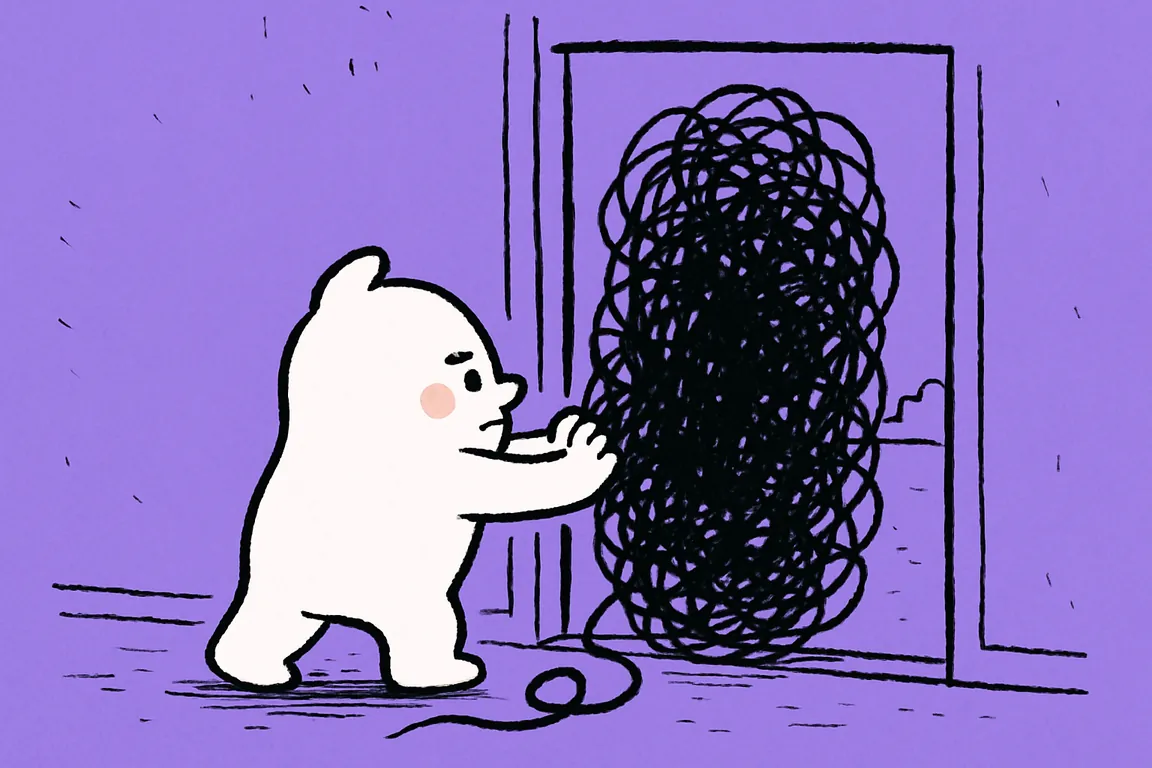
The other standard move, pushing the thought out, does the same job backward. Trying to suppress an intrusive thought brings it back more often. So you end up with two full-time jobs: proving the thought false and keeping it out. Both are compulsions wearing normal clothes.
If you’re mid-loop right now, the practical piece is in our guide on how to stop feeding an OCD spiral.
Why does my intrusive thought feel so real?
Partly because you’ve reviewed it so many times. Vividly imagining an event increases people’s confidence that it really happened, which means the mental replay you’re doing to settle the question is quietly making the memory feel more solid and the fear more plausible.
Add a body full of adrenaline and you get something that feels like knowledge rather than anxiety. It isn’t proof either way. There’s more on that in our piece on why OCD feels so real.
How to respond when an intrusive thought lands
- Let it be there. Don’t push, don’t pray it away, don’t replace it with a good thought. You’re allowed to have a thought you didn’t order.
- Skip the meaning question. “What does this say about me” is the compulsion in question form. Answering it once always means answering it again.
- Don’t check anything. No googling the thought, no confessing, no scanning your body for the right feeling, no asking someone close to you to settle it.
- Ride the spike instead. Anxiety rises, peaks and falls when nobody feeds it. If it helps to have something to hold onto while it does, ride the free wave.
- Carry on with the thought still there. Go back to the conversation, the washing up, the shift. Taking the thought with you is the practice. Waiting until it’s gone is the ritual.
- Notice what surprised you. Each time you face the trigger and skip the ritual, you build new learning that competes with the old alarm, and surprise is what makes it stick. The thought showed up, you did nothing about it, and the day continued.

When is it more than a normal intrusive thought?
Nobody can diagnose you from an article, and this one isn’t trying to. But the questions a clinician asks are less about content and more about cost: how much of your day goes to the thought, what you’ve stopped doing because of it, whether you’ve built a life around avoiding the trigger, and how much you have to do to make the feeling settle.

If that’s the shape of it, the treatment is exposure and response prevention, ERP, which is steps 1 to 6 above done on purpose and on a plan rather than in an emergency. It has a deep evidence base, which we’ve laid out in the research behind ERP, and you can start structuring it yourself with our guide to doing ERP at home. A specialist is the better option when you can reach one.
What ERP doesn’t promise is a mind without intrusive thoughts. Nobody has that, which was the whole point of the first section. What changes is how much of your life they get to run.
 Straight answers
How many intrusive thoughts a day is normal?
There's no normal number, and counting them tends to make them more frequent. Studies of people without OCD find these thoughts arriving regularly rather than rarely, with huge variation between individuals and weeks. The useful measure isn't frequency, it's cost: how long each one holds you, and what you do to resolve it.
Do my intrusive thoughts mean something about me?
Maybe, maybe not. That's the honest answer, and it's also the only one that doesn't feed the loop. The research is clear that content doesn't sort people into safe and dangerous, because the same content shows up in people with no OCD at all. Chasing a verdict is the compulsion, not the cure.
What's the difference between an intrusive thought and an obsession?
An obsession is an intrusive thought that got promoted. Same content, different job: it's been read as urgent and meaningful, so it recurs, sticks, and demands a response. The response, mental or physical, is what keeps it returning. Clinicians look at that cycle rather than at what the thought was about.
Can you get rid of intrusive thoughts completely?
No, and be suspicious of anything promising otherwise. They show up for nearly everyone, everywhere, and trying to suppress them reliably increases how often they come back. What treatment changes is the grip: less time lost, less fear when one lands, fewer rituals attached to it. The thoughts pass through instead of setting up camp.
 Keep reading
Written by Edwin Simonds and checked against every source cited above. Not medical advice.